Terre Haute

Terre Haute - A history and a guide

This is my history and guide to my adopted home - Terre Haute, Indiana.

Old Postcards - 21

More postcards from my collection...

Chauncey Rose Memorial, Fairbanks Park

Chauncey Rose Memorial, Fairbanks Park

This unused postcard has just the following printed text...

Photo by John V. Pontiere, Jr.
Estell Wholesale Co., 518 Arrowhead Dr., Seymour, Ind. 47274

Chauncey Rose was born on December 24th, 1794, in Wethersfield, Connecticut into a farming family. Chauncey journeyed through several states before deciding at the age of 23 to settle in the Wabash Valley in 1817. He spent seven years running a logging and milling operation in Parke County, north of Vigo County, before returning to Terre Haute in 1824. He bought much of the land that today is between Poplar and Chestnut Streets from Seventh Street to nearly the present campus of Rose-Hulman Institute of Technology - a move that at the time seemed highly speculative but ended very profitably for Chauncey. Owning several properties, including the Prairie House Hotel at Seventh and Wabash, he saw the value in developing the town and invested in canals, municipal improvements and the railway. For example, in 1847 he organized the Terre Haute and Indianapolis Railroad. Like other of Terre Haute's successful businessmen he was also a great philanthropist and was very generous to the town's Providence Hospital, the Free Dispensary, the Rose Orphan Asylum and other libraries and colleges. Chauncey formed a corporation on September 10, 1874 known as the Terre Haute School of Industrial Science, which in 1875 and against his wishes, was renamed Rose Polytechnic Institute and later still, in 1971,  became the Rose-Hulman Institute of Technology. Altogether, he donated over a million dollars to the town, a huge sum in the 19th century, before his death in Terre Haute on August 13th, 1877.

The memorial was dedicated in 1936 and stands in Fairbanks Park. The memorial is made from elements, such as the columns, triangular entablatures and eagle sculptures, taken from the old Post Office that had stood at the corner of Seventh and Cherry Streets from 1884, and which was demolished in 1932.

Sunken Gardens, Henry Fairbanks Memorial Park

Sunken Gardens, Henry Fairbanks Memorial Park

This unused postcard has just the following printed text...

OB-H1089
Wabash Valley News Agency Inc., Terre Haute, Ind.
Genuine Curteich-Chicago "C.T. Art-Colortone" Post Card (Reg. U.S. Pat. Off.)

Fairland Park

Fairland Park

This used postcard, stamped in Terre Haute on 13th July 1910, has just the following printed text - 8906

Situated near Brown and Wabash Avenues and originally known as Lake View Park this appears to have been a privately owned park. Whilst it was called Lake View Park it was operated by Henry Breinig. Over the winter of 1907/08 it changed hands and became the property of the Terre Haute Amusement Co. with August Fromme assuming duties as president and general manager. Brothers August and Herman Fromme maintained several successful businesses at the southwest corner of Seventh and Hulman Streets and August retained the park's flourishing features but altered others to attract more family gatherings. It reopened on June 7, 1908 as Fairland Park.

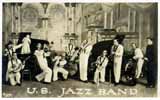
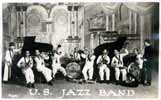
Perhaps the most significant change instituted at Fairland Park was the admission charge, reducing it from 25 cents to ten cents. Children under 10 were admitted free. In an effort to encourage families to spend the day at the park, intoxicating beverages were barred and the once popular daily buffet was discontinued but the picnic facilities were expanded. Vaudeville also was terminated. Instead of "charging for inferior acts," Fromme intended to use the theater to offer free motion pictures. Free band concerts and a variety of high class circus and animal acts became the chief forms of live entertainment. While Lakeview Park engaged bands for one day exhibitions, Fromme secured popular bands for a week at a time. Shows were available every afternoon at 3 p.m. and every night at 8 p.m. The opening attraction on Sunday, June 7, was the Great Dixie Band, hailed as "the official band of the State of Texas."

The photograph on the above card was used to advertise the original Lake View Park as early as 1907.

Federal Penitentiary, Terre Haute

Federal Penitentiary

This unused linen fronted postcard has the printed text...

Photo by Ben Thiede
OB-H2200
Wabash Valley News Agency Inc., Terre Haute, Ind.
Genuine Curteich-Chicago "C.T. Art-Colortone" Post Card (Reg. U.S. Pat. Off.)

Another copy of this card was posted in Terre Haute on November 23rd, 1955.

Federal Penitentiary, Terre Haute

Federal Penitentiary

This postcard, stamped in Terre Haute on August 28th, 1962, has the printed text...

U.S. Federal Penitentiary
Terre Haute, Indiana
Main gate, Federal Penitentiary

P22392
Pub. by Wabash Valley News Agency Inc., Terre Haute, Ind.
Plastichrome by Colorpicture Publishers, Ind., Boston 15, Mass., U.S.A.

A new United States penitentiary was authorized by President Franklin D. Roosevelt in 1938 and established in Indiana on October 3rd, 1940 on 1,126 acres of land in Honey Creek Township just south of Terre Haute. The opening of the prison was partly due to heavy promotion by Terre Haute's Chamber of Commerce which raised $50,000 to pay for the property on which the prison was built. It was the first penitentiary for adult felons ever to be constructed without walls, which can be seen from the postcard view.

The Terre Haute Camp was added in 1962 with the purpose of housing non-violent felons to perform farm and maintenance duties. The federal death penalty was reinstated in 1988, after a 16 year moratorium beginning in 1972. In 1993, Terre Haute became the only federal prison in the United States to house a death row, this facility was completed in 1995. It was selected due to its geographic location in the center of the country and the fact that it already was a high-security prison that housed some of the nation's most dangerous inmates. This institution carries out executions of inmates by means of lethal injection.

The first death sentence to take place at the prison was June 11, 2001 with the execution of Timothy McVeigh, who was convicted in the 1995 Oklahoma City bombing. On June 19, 2001, Juan Raul Garza became the second person executed at Terre Haute, for his involvement in three drug-related murders that occurred in 1993. On March 19, 2003, Louis Jones Jr. became the third person executed at this institution, for kidnapping, raping, and killing 19-year-old Tracie Joy McBride.

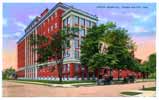
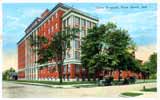
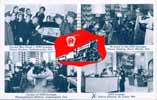
Filbeck Hotel, Terre Haute

Filbeck Hotel

This unused postcard also contains the text...

165313
Historical Collectors Series
Exclusive Project by the House of Photography
Robert W. Harvey with the help of Dorothy J. Clark, Local Historian

Old Filbeck Hotel
Stood at the Northeast corner of 5th & Cherry Streets. Named after Nicholas Filbeck who was a Civil War hero , and Terre Haute Post Master. This hotel was constructed after1880 and razed in 1961. Was Hdqts. for most theatrical people who visited Terre Haute.

This hotel, here pictured in the 1890's, stood on a site once occupied by the Pavilion, Johnson House and old Filbeck Hotels. It was demolished in 1961 and the site used for the 500 Cherry Street Corporation parking lot and the site is now part of the Indiana State University campus.

First Methodist Episcopal Centenary Church, Terre Haute

First Methodist Episcopal Centenary Church

This unused postcard also contains the text...

24
Published by I. & M. Ottenheimer, Baltimore, Md.

The history of this church is the history of the First Methodist Episcopal, Centenary Methodist Episcopal Churches and United Methodist Temple and is a little confusing...

The United Methodist Temple (not the one in the above postcard image) was originally founded in 1826 as Asbury Chapel on land at Fourth and Poplar Streets that was set aside by the city to be given to the first church group to erect a building on it. The first Methodist church in Terre Haute was built on the site in 1833. Repairs, increased need for parking, and the population shift were the determining factors in the decision to move the church to Seventh and Poplar Streets.

The First Methodist Episcopal church (not the one in the above postcard image) was located on the northwest corner of Seventh and Poplar Streets. The cornerstone was laid in 1894 and it was dedicated on May 26th, 1895 at a cost of $45,000. In 1900, it was described as "the most costly and elegant Protestant church in the city." The building changed name in 1925 to the Methodist Temple when it merged with the Centenary Methodist church. This agreement ended in 1929. In 1969, the congregation moved to the New Methodist Temple which was built at 5301 South U.S. Highway 41. The original building at Seventh and poplar was demolished shortly after this move and the Vigo County Public Library was erected on the site.

The original Centenary Methodist Church was built in 1866, the centennial year of Methodism in America, at 301 North Seventh Street. That building was demolished and a new building, the one in the above postcard image, was built in 1904. It was almost totally destroyed by fire in 1916 and the New Centenary Church was built on the site in 1917.

This page created 20th February 2008, last modified 14th May 2008