This is part of my history and guide to my adopted home - Terre Haute, Indiana.
The Glaciers
Why is Indiana and much of the surrounding states so flat?
The Earth has undergone many ice ages, the first being around 700,000 years ago. The last was about 20,000 years ago. Much of Indiana was covered by a glacial ice sheet many hundreds of metres thick. This last great glacier is called the Wisconsin Glacier. The glaciers had a scouring effect on the land and this great expanse of ice carried much sediment with it. When the ice retreated northwards, ending about 10,000 BC, the sediment, sometimes hundreds of feet thick, filled in many of the valleys that were once in the region and leaving behind it many areas that became bogs. The crushing weight of the ice only got around two thirds of the way into Indiana before it retreated, this explains the flatness of the north of the state while the south has rolling hills. The huge amount of sediment deposited by the glacier, which in places is hundreds of feet deep, also explains the rich farming land that makes up much of Indiana.
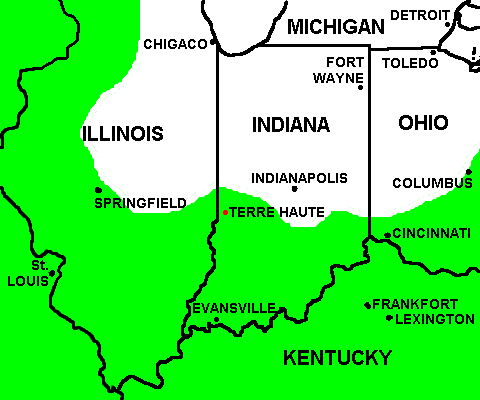
Extent of the Wisconsin glacier - 18,000 years ago
Around 12,000 BC, mammoths, mastodons, caribou, giant bison, giant beaver, peccary, deer, dog, coyote, birds, turtles, and fish inhabited the mostly spruce covered countryside. Over the centuries the glaciers, and the spruce, retreated northwards.
The high water table is the state's water supply. About 60 - 72 percent of Indiana's population relies on ground water for drinking and household uses. In 1995 it was estimated that 1.52 million people were supplied water from private domestic wells, and 2.1 million people were supplied by public water supply systems from a ground-water source. Approximately 303 million gallons per day of ground water was pumped by public water supply systems registered as significant water withdrawal facilities (100,000 gallons per day capacity) in 1992. Approximately 4,200 public water supply systems and countless industries use ground water as their source of water.
The Clovis People
About 12,000 BC, what are known as the Clovis people first arrived in what was to become the United States of America. There are three main theories about the origins of the Clovis people :-
The retreating glaciers allowed humans from Asia in the north west to enter through Alaska.
They migrated northward from South America, specifically from Chile or Peru.
They were Europeans who sailed the Atlantic, hugging the ice sheets to the north around Greenland.
Whatever their origins, four thousand years later, in the Archaic Period, they inhabited every part of the United States, from coast to coast, from cold southern Canada to Mexico. The remains of their settlements and artifacts, especially their distinctive arrow and spear heads, can be found all over America. These were hunter gatherers and may have been responsible for the extinction of several species of animals.
The Clovis people were the first people of what is known as the Paleo Indians. These cultures, the Clovis, Folsom and Plano flourished around 10,000 BC. For 4,000 years the climate changed, growing gradually warmer and the Indians had adapted to the changing conditions, ushering in the Archaic Period. The people of the Archaic Period weren't very different from the Paleo Indians. The invention of new tools for hunting and fishing, baskets and nets meant there was the opportunity for trade in food, raw materials and finished goods with the emerging, differing cultures of the period. During the Archaic Period, from around 6,000 BC to 1,500 BC, the colonisation of the North American continent, by what were to become the Native American Indians, was complete, and people were able to live in previously uninhabitable places.
The Woodland Period
From 1,500 BC to around 1,000 AD came the Woodland Period. As the climate changed so did the lifestyles of the human population of North America. As the larger mammals began to die out in many areas then the people had to hunt smaller game. To supplement their diet more use of made of local vegetation. Dwellers along coastal regions learned how to take advantage of the sea for their food. The introduction of agriculture meant that the people could settle, or at least become semi-nomadic. It was during this time that the use of pottery and the bow and arrow became widespread. The political, social, cultural and geographic boundaries became more obvious and maps, such as the one below, can be drawn of them.
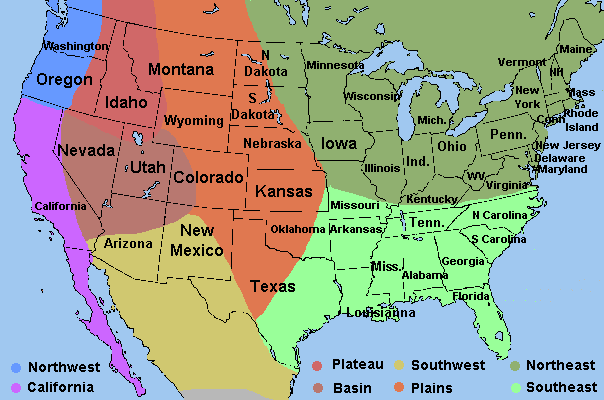
Cultural areas of the Woodland Period (approx 1,000 BC)
The areas are only a rough guide, the Indian cultures would have changed gradually depending on the local climate, vegetation, animals, and with allegiances and contacts with nearby groups of people.
From around 3,000 BC the people who inhabited the Northeast and Southeast regions first started building the great mounds. The mound building went on to at least 1800 AD. There appear to be several forms of mounds, the first seem to be burial mounds but others seem to have had more cultural or religious significance.
The final stage of Native American development is the Mississippian, this lasted from around 1,000 AD to around 1,600 AD, around the time when Europeans found North America and began to work their way westward across the new land.
Native American Nations
Before I started writing this I thought that there were only a handful or so Indian tribes, the Cherokee, Crow, Apache, Mohawk etc. which are the ones I saw depicted in Westerns. Once I started reading material for this site I realised that there are dozens of them. Although I'm interested in the tribes that lived or passed through Indiana here is a list of American Indian nations and tribes by the areas outlined above.
Northeast
Abenaki, Algonkin, Beothuk, Cayuga, Chippewa, Delaware, Erie, Fox, Ho-Chuck, Huron, Illinois, Iroquois, Kickapoo, Lumbee, Mahican, Mascouten, Mashantucket, Massachuset, Mattabesic, Mattinnecock, Menominee, Metoac, Miami, Micmac, Mingo, Mohegan, Mowhawk, Montagnais, Montauketts, Nansemond, Narragansett, Nauset, Neutrals, Niantic, Nipissing, Nipmuc, Ojibwe, Oneida, Ottawa, Pamunkey, Pennacook, Penobscot, Pequot, Pocumtuck, Potawatomi, Powhatan, Sauk, Shawnee, Susquehannock, Tionontati, Tuscarora, Tuscarora (Southern), Wampanoag, Wappinger, Wea, Wenro, Wikwe, Winnebago, Wiyot, Wyandot, Wyandote, Wyandotte.
Southeast
Acolapissa, Asis, Alambama, Alibamu, Apalachee, Atakapa, Bayougoula, Biloxi, Calusa, Catawba, Chakchiuma, Cherokee, Chesapeake Algonquin, Chickasaw, Chitamacha, Choctaw, Cosushatta, Coushatta, Creek, Cusabo, Gaucata, Guale, Hitchiti, Houma, Jeags, Karankawa, Keetoowah, Lumbee, Miccosukee, Mobile, Napochi, Nappissa, Natchez, Ofo, Oklahoma, Powhatan, Quapaw, Seminole, Southeastern Siouan, Tekesta, Tidewater Algonquin, Timucua, Tunica, Tuscarora, Yamasee, Yuchi.
Plains
Arapaho, Arikara, Assiniboine, Assiniboine (Souix), Bidai, Blackfoot, Caddo, Cheyenne, Comanche, Cree, Crow, Dakota (Sioux), Fox, Gros Ventre, Hidatsa, Iowa, Ioway, Kansa, Kaw, Kiowa, Kiowa-Apache, Kickapoo, Kitsai, Lakota (Sioux), Mandan, Mendota, Metis, Missouri, Nakota (Sioux), Omaha, Osage, Oti, Otoe, Pawnee, Peoria, Ponca, Sauk, Sarsi, Shawnee, Siouan, Sioux, Sutai, Tonkawa, Waccamaw, Wahpeton, Wea, Wichita, Wowapi.
Great Basin
Bannock, Crow, Omaha, Paiute (Northern), Paiute (Southern), Sheepeater, Shoshone (Northern), Shoshone (Western), Ute, Washo.
Plateau
Carrier, Cayuse, Coeur D'Alene, Colville, Dock-Spus, Eneeshur, Flathead, Kalispel, Kawachkin, Kittitas, Klamath, Klickitat, Kosith, Kutenai, Lakes, Lillooet, Methow, Modac, Neemeepoo, Nez Perce, Okanogan, Palouse, Sanpoil, Shushwap, Sinkiuse, Spokane, Tenino, Thompson, Tyigh, Umatilla, Wallawalla, Warm Springs, Wasco, Wauyukma, Wenatchee, Wishram, Wyampum, Yakima.
Southwest
Acoma, Apache (Eastern), Apache (Western), Chemehuevi, Coahuiltec, Cochiti, Comanche, Dineh, Hohokam, Hopi, Isleta, Jano, Jemez, Jicarilla, Kiowa, Laguna, Manso, Maricopa, Mohave, Nambe, Navaho, Pai, Papago, Picuris, Pima, Pojoaque, Pueblo, Sandia, San Felipe, San Ildefonso, San Juan, Santa Ana, Santa Clara, Santo Domingo, Taos, Tesuque, Tohono O'Odham, Yaqui, Yavapai, Yuman, Zia, Zuni.
Northwest
Calapuya, Cathlamet, Chehalis, Chemakum, Chetco, Chilluckkittequaw, Chinook, Clackamas, Clatskani, Clatsop, Cowich, Cowlitz, Elwha, Haida, Hoh, Kalamath, Klallam, Kootenai, Kwakiutl, Kwalhioqua, Lushootseed, Makah, Molala, Multomah, Neemeepoo, Nez Perce, Onondaga, Oynut, Ozette, Pomo, Queets, Quileute, Quinault, Rogue River, Salish, Siletz, Steilacoom, Suquamish, Swinomish, Taidhapam, Tillamook, Tolowa, Tsilhaot'in, Tutuni, Washoe, Yakama, Yakonan.
California
Achomawi, Atsugewi, Cabazon, Cahuilla, Chimariko, Choinummi, Chumash, Costanoan, Esselen, Hupa, Juaneno, Karuk, Kawaiisu, Maidu, Mission Indians, Miwok, Mono, Paiute, Patwin, Pomo, Serrano, Shasta, Tachi Yokut, Tolowa, Tubatulabal, Wailaki, Wintu, Wiyot, Yaha, Yokuts, Yuki, Yuman (California).
These early nations can be further defined by modern day states:
Alabama - Choctaw, Creek, Mobile
Arizona - Apache, Chiricahua, Cocopah, Coyotero, Havasupai, Hopi, Maricopa, Mojava, Opata, Pima, Pinal Arivaipi, Thono O'odham, Walapai, Yaqui, Yayapai, Yumi, Zuni
Arkansas - Caddo, Chakchilma, Quapaw
California - Cahhulla, Chemehueyi, Chumash, Costana, Diegueno, Esselen, Gabriallino, Luiseno, Maidu, Miwok, Modoc, Mojawa, Mono, Panamint, Patwin, Salinan, Serrano, Shasta, Wintun Pomo, Wiyot Yuki, Yokuts, Yurok
Colerado - Arapaho, Cheyenne, Comanche, Kiowa, Navajo, Ute
Connecticut - Narraganset, Whappinger
Georgia - Apola, Creek, Cusabo, Edisto, Guale, Sawokli, Yamasi, Yuchi
Idaho - Bannock, Blood, Coer D'alene, Lemni, Nez Perce, Pend D'orielle, Shoshone, Wind River Shoshone
Illinois - Chahokia, Illinois, Kaskaskla, Moingwena, Peoria, Tamaroa
Indiana - Delaware, Huron, Miami, Kickapoo, Mingo, Munsee, Ottawa, Piankasha, Piankenshaw, Pottawattomi, Shawnee, Shockey, Stockbridge, Wea, Wyandot
Iowa - Omaha, Moingwena, Potowatomi
Kansas - Cheyenne, Kansa, Kiowa, Osaga
Kentucky - Shawnee
Louisianna - Bikloxi, Chawasa, Chitmacha, Natchez, Tunica, Washa
Maine - Malecite, Micmac, Passamquoddy, Pennacook, Penobscot
Maryland - Conoy, Nanticoke
Massachusetts - Massechuset, Narraganset
Michigan - Cree , Ottawa, Menomini
Minnesota - Iowa Saukefox, Ojibwa, Santee Dakota, Wahpeton
Mississippi - Biloxi, Chakcchilma, Choctaw, Mobile, Natchez, Taposa, Tunica
Missouri - Missouri, Osaga
Montana - Atsina, Blackfoot, Blood, Crow, Flathead, Kootenay, Pend D'orille, Piegan
Nebraska - Cheyenne, Omaha, Oto, Pawnee, Ponca
Nevada - Gosiute, Modoc, Mono, Northern Paiute, Panamint, Southern Paiute, Western Shoshone
New Hampshire - Mahican, Nauset , Nipuc, Pennacook
New Mexico - Apache, Arivaipi, Comanche, Coyotero, Faroan, Gileno, Jicarilla Apache, Mescalero, Mimbreno, Opata, Pinal, Pueblo, Zuni
New York - Abnakt, Cayuga, Delaware, Iroquois, Mohawk, Naticoke, Oneida, Onondaga, Seneca, Stockbridge, Unalachtigo, Whappinger
North Carolina - Cherokee, Pamlico, Saponi, Secotan, Tuscarora, Tutelo
North Dakota - Arkikara, Assiniboin, Blackfoot, Hidatsa, Mandan
Ohio - Eire, Huron
Oklahoma - Caddo, Wichita
Oregon - Chinok, Kalapuya, Karok, Klamath, Kusa , Siletz, Siuslaw, Till-amok, Tutunti, Umatilla, Wailaptu, Walpapi, Yakjim Tenino, Yaquina Alsea
Pennsylvania - Delaware, Montalik, Munsji, Nanticoke, Susquehanna, Unalachtigo, Wappinger
Philidelphia - Wappinger, Montalik, Delaware, Unalachtigo
South Carolina - Cape Fear, Catawba, Coree, Cusabo, Edisto, Sewee, Stono, Yuchi
South Dakota - Brule, Hunkpapa, Oglala, Sana Arc, Sioux, Teton Dakota, Yanktonai Pakota
Tennessee - Cherokee, Chickasaw, Shawnee
Texas - Alabama Coushatta, Apache, Atakapa, Caddos, Chickasaw, Cherokee, Choctaw, Coahuiltec, Comanche, Karankawa, Kichai, Kickapoo, Li-anero, Lipan Apache, Mescalero Apache, Shawnee, Tawakoni, Tonkawa, Waco
Utah - Gosiute, Navajo, Shoshone, Ute
Vermont - Mahican, Nauset, Nipuc
Virginia - Conoy, Monacan, Nottoway, Powhatan, Weapemeoc
Washington - Chehaus, Chinok, Coeur D'alene, Cowutz, Kuaspel, Makah, Methow, Nuth Chal Nuth, Palus, Quinalt, Squamish, Walla Walla
West Virginia - Conoy, Monocan, Uninh
Wisconsin - Kickapoo, Menomini, Potawatomi, Saukefox, Winnebago
Wyoming - Cheyenne, Crow, Teton Dakota, Wind River Shoshone
The above lists were compiled with material from several sources and are by no means definitive. The Delaware, for example, had their original homeland in New York state, but by 1900 had moved, or had been forced to move, nearly halfway across the North American continent.
Sources & Resources
The Ice Age in Indiana
Ice Ages - Illinois State Museum
Ice Ages and Glaciation - Hartwick College (Internet Archive)
Clovis People
Clovis and Beyond - (Internet Archive)
Clovis Complex - Native Peoples of North America: History and Culture (Internet Archive)
The Clovis First / Pre-Clovis Problem - Paleoindian & Other Archaeological Stuff (Internet Archive)
Clovis Points - Smithsonian Institution (Internet Archive)
Midwest U.S. 16,000 Years Ago - Illinois State Museum (Internet Archive)
Monte Verde Excavation - University of Nebraska - Lincoln (Internet Archive)
Paleo Indians, Archaic, Woodland and Mississippian Periods
An Introduction to the Prehistory of Indiana - Glenn A. Black Laboratory of Archaeology (Internet Archive)
The Paleo, Archaic, Woodland and Mississippian Periods - Hutchison Research Center (Internet Archive)
The Mounds and the Mound Builders
Ancient Mound Builders - Earthworks (Internet Archive)
Angel Mounds, Indiana - (Internet Archive)
Dickson Mounds, Illinois - (Internet Archive)
Indian Mounds of the United States - (Internet Archive)
Moundbuilders - (Internet Archive)
Who Were the Mound Builders? - Hutchison Research Center (Internet Archive)
Native American Sites
American Indian History - Manataka (Internet Archive)
Culture: Native American - Essortment (Internet Archive)
First Nations Histories(Internet Archive)
First Nations Issues of Consequence
Indian Tribe Names - Running Deer's Longhouse (Internet Archive)
Indians of northern Indiana - Essortment (Internet Archive)
Map of American Indian Tribes - Running Deer's Longhouse (Internet Archive)
Miami Documents - Glenn A. Black Laboratory of Archaeology (Internet Archive)
Native American Culture - Great Dreams
Native Languages of the Americas
Photographs 1890 to 1930 - The Curtis Collection (Internet Archive)
Specific Tribal or Nation Resources - About (Internet Archive)
Treaties Between the United States and Native Americans - The Avalon Project at the Yale Law School (Internet Archive)
Tribal Name Meanings And Alternative Names - North American Indian History
Tribes (Internet Archive)
General American History Sites
A Chronology of US Historical Documents - University of Oklahoma, College of Law (Internet Archive)
An Outline of American History (Internet Archive)