Introduction
Every now and then I get emails from people who would like further information on specific questions they have about Bristol. I've got an extensive set of references but obviously these can't cover absolutely everything about or everyone who's ever lived in Bristol. Besides which, some aren't indexed properly and although I pretty well know most of the contents, I'll sometimes miss information. Set out below are some items I would like to know more about.
I know some people are worried about giving their email addresses to all and sundry so I will not post your email addresses here. When and if someone replies, I shall forward the reply to you and inform the answerer that I have done so. It is then up to you to reply to them or not but I hope you'll both include me with any information so I can update these pages. Where the writers have no objection to people contacting them directly, I've included their email address under the article. We'll be grateful for any information at all on these subjects.
You can email me at
I try to answer as many emails as I can but please don't be surprised if you don't hear from me for several weeks, sometimes even longer. Please remember that doing this research and writing my sites are a hobby and I have other interests.
Henbury Cemetery Records
Original query from Jeannine
Jeannine is looking for a list of the cemeteries and burial records of the churches in Henbury. The reason she wants these is because she's looking for the resting place of an ancestor of hers, Francis Hall, Jr., who died in Henbury on 8th December, 1620.
Reply from Ray
"A Guide to Henbury" compiled by the Hallen and Henbury Women's Institute was originally published in 1958, the information below comes my 1970 second edition.
Apparently, Henbury was at that time a huge parish. It included the villages and hamlets, including Aust, Brentry, Charlton, Hallen, King's Weston, Lawrence Weston, Northwick, Redwick and Sea Mills. The main church is St. Mary the Virgin in Station Road. A picture of the church, taken from the booklet is reproduced below.
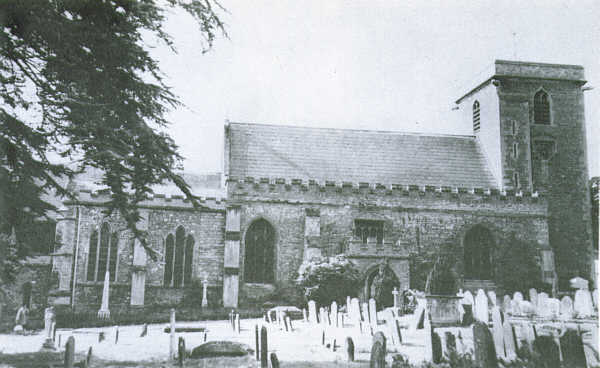
St. Mary the Virgin church, Henbury
(from "A Guide to Henbury" compiled by the Hallen and Henbury Women's Institute, 1970)
Henbury Court Hotel
Original query from Jane
Henbury Court Hotel built by Henry Stock in 1807, does anyone know if this building is still standing, or where it was?
Reply from Ray
I found this information in the booklet "A Guide to Henbury" compiled by the Hallen and Henbury Women's Institute. Originally published in 1958, this comes from the 1970, second edition.
Just across the road from the Manor house, opposite the roadway leading to the north door of the Church are some railings enclosing an old orchard. This was the site of the Great House, rebuilt by Sir Simon Harcourt in 1708. It stood in the angle between Gloucester Lane and the Turnpike road on it's eastern side. Gloucester Lane is now (or was in 1970, Station Road).
That is on page 22. I included it because on page 26 it says ...
Thomas Stock, the sugar refiner, who had bought the Great House and then pulled it down, built Henbury Court in 1807. His daughter Marianne states that he lived there for 26 years, and died there in 1833. He was a man of resolute mind, facing the total destruction of his Bristol warehouse by fire in 1813 with much fortitude.
After a meeting with John Wesley in 1791, just before the latter's death, Stock became an ardent Methodist and he and his delicate wife frequently went to chapel services at 5.0 a.m. As their daughter writes:-
My mother would not yield to the fascination of slumber but resolutely arose and in the dark, cold wintry mornings sallied forth, with lantern and pattens, to take her part in these devotional exercises.
She stopped wearing jewellery and they both gave up cards, dancing and the theatre.
Henbury Court was the home of ten orphaned children, as Stock provided for his six nephews and nieces and for his four grandchildren.
Stock's great friend was the Vicar, the Revd. Walter Trevelyan, who was a keen naturalist. Amongst visitors to the Court were Hannah More, William Wilberforce, Adam Clarke, the brilliant Methodist scholar, the Moravian historian, Mrs. Schimmelpennick, the sentimental novelist Mrs. Amelia Opie, and Elizabeth Fry, the great prison reformer.
In 1897 Admiral John Halliday Cave owned the Court and in that year sold it to Sir Thomas Lennard who added to it a winter-garden, picture gallery, music-room and loggia. He built terraces in the garden where a statue of Hebe feeding the swans stood by a classical fountain.
In the early years of this century [the 20th, not the 21st] the house became successively a hotel and then a Children's Home. In 1953 it was demolished to make room for flats on the Henbury estate. The contractor took out the old panelling which was of first rate craftsmanship but to his surprise no one would buy it or even accept it gratis.
The old gateway and a piece of stone walling, deeply carved with the words "Henbury Court" still stand forlornly on the edge of the new estate in Station road. Its name is also remembered in the name of Henbury Court School, but only these few relics remain. Its Dower House, much renovated, is being used today as a private dwelling, and the large summerhouse or chalet, once in its garden, still stands in the centre of the new estate, flanked by tall blocks of modern flats.
Hill End House, Henbury
Original query from Jenny
Jenny asks about the Good Shepherd Convent and St. Raphael's Mother and Baby Home. According to a short history of these places, the Good Shepherd Convent moved from Arno's Court, Brislington to Hill End House, Henbury in 1948. St. Raphael's Mother and Baby Home was set up in Severn House, Henbury a little later.
Jenny would like to know something more about all of these places. I know nothing about Hill End House or Severn House, where they were or if they are still standing.
In December 2012, I had an email from Vicki. She wants to know where the records for these homes are now. The closest I've seen to this is a page on RootsChat, but even these do not know where the records are kept.
Reply from Mike
I received an email Mike who actually lives in Severn House. He very kindly sent a photograph of the building and a brief history.
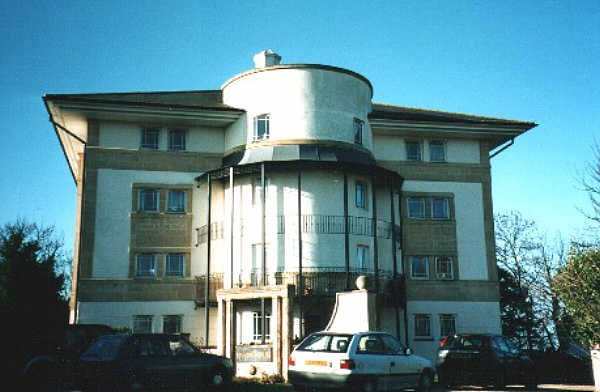
Severn House
Image by Mike Matthews
Mike writes, "The house was built c. 1820 and designed by George Repton, the younger son of Humphry. However I haven't been able to confirm this. I also don't know who it was originally built for. The 1841 census shows Johanna Sawyer, aged 46, born outside the UK, living at Severn House with four children. A Mrs. Sawyer is also listed at Severn House in the 1853 street directory.
In 1861 Alfred George is listed as living at Severn House. The 1861 census shows an Alfred George, 63, brewer, living in a property on Ison Hill Road, which was probably Severn House. However by 1865 an E. Perceval was living at Severn House. This was, I believe, Ernest Augustus Perceval, the youngest son of the British Prime Minster, Spencer Perceval. Ernest is shown at Severn House in the 1871 census, although he's in Tenby in 1881 (perhaps on holiday!) Ernest died in 1896 but in the 1901 census his children Spencer, Jane, Beatrice, Frederica and Emma were all still living in Severn House.
The street directories show the occupants of Severn House as the Mrs. Perceval in 1904, the Rev. John Waterfield B.A. (curate) in 1914, and Captain Gilbert Leonard Stratton M.C. from 1928-1935. I believe the house was purchased by the Good Shepherd Convent in the late 1940s and run as a hostel for unmarried mothers and babies until the 1970s.
Holy Cross RC School, Dean Lane, Bedminster
Original query from Andy
Andy is a teacher at the Holy Cross school and writes, "From reading the diocesan history I have discovered the school has a long history in the Bemmy area, moving to different places and eventually being bombed. I was wondering if you or any of your readers/Bemmy locals have any more they can add to our history and perhaps this info can become part of our teaching in school. I would be grateful for any memory, photo or information you can offer."
Holy Trinity, St. Phillip's
Original query from Karen
Karen writes "I am trying to find out when Holy Trinity, St. Phillip's ceased to be used as a church and what happened to the graves. I did read somewhere that the graves were moved in 1933 and were moved to Greenbank."
Horfield Prison
Original query from Audrey
Audrey writes "I am trying to get details of the last man hanged at Horfield prison. I believe his surname was Withey and that he was hanged for the murder of his wife's lover.
Reply from Ray
A search on the Internet did come up with only one case of hanging at Horfield and that was Miles Giffard in 1953. He was hanged for killing his parents.See Real Crime UK Internet Archive) and Wikipedia. In June 2000, someone asked me about the gallows at Horfield and so I rang the prison. They couldn't tell me when it was last used or when it was taken away.
An email in October 2013, from Andy Griffin made me look again at this question. Andy said that John Withey was hung on April 11, 1889 and the last person hanged there was Russell Pascoe on December 17, 1963.
John Withey had killed his wife, Jane. Paul Townsend has written the story of the murder on Flickr (Internet Archive). One little snippet not in that article was that the hangman was James Berry.
The Capital Punishment U.K. site lists all the executions, they can be searched for just those taking place in Bristol. There were 14 at Bristol's Horfield Prison.
Industrial Schools
Original query from Julie
Julie writes, "I am trying to find out about the Sisters of Charity Industrial Schools. My Grandmother and her sister were residents of Oriel Lodge Walton in Gordano North Somerset. In 1896 they had a new school built in Knowle, Bristol. Have tried to find out about both of the schools but have had no luck. I have been trying to find out if there is a register to tell why and who placed my grandmother and her sister there. Bristol Archives and Somerset Archives are unable to help. Nobody seems to know anything about this Industrial School. If any one knows of them I would be very grateful for any information."
Julie later emailed to say that "A Sir E. Elton Bart. was paying for them to attend the school." and that he possibly had connections to Clevedon Court
Reply from Ray
I've no idea who would hold these records, but there are some sites that seem to specialize in the history of these schools and other institutions. You could try Industrial Schools (Internet Archive), Rossbret Institutions (Internet Archive), Strays Project (Internet Archive), or The Workhouse sites.
As for Sir E. Elton. First of all I thought he might be Sir Edward Marwood Elton. He was lawyer and lived from 1801-1884. The problem is, he was more from Devon than around Bristol. Looking at the history of Clevedon Court, the place was home to the Elton's since 1709. There is more about this at the Eastmond Homepages (Internet Archive), Steve Hutchings Budgie's (Internet Archive), and lots more on Google.
Johnny Ball Lane
Original query from Carole
Carole would like to know the history of Johnny Ball Lane.
Reply from Ray
About a quarter of a mile to the northwest of Bristol Bridge is the very narrow Johnny Ball Lane which runs from Lewins Mead to Upper Maudlin Street. According to "An A-Z History of 200 Bristol Street Names" by Grace Cooper, 1989, Johnny Ball Lane was named after John a Ball who owned the property adjoining the Franciscan Friary (Greyfriars) in Lewins Mead. It was originally called Bartholomew Lane because St. Bartholomew's hospital had a gateway at the foot of Christmas Steps. John a Ball is said to be partly responsible for the building of the first Bristol Bridge beyond Bristol Castle in Norman times.
Keetch Family
Original query from Mike
Mike is looking for information on the Apsey and Keetch families. He wrote, "Two rather distant relatives married people named Keetch. Malachi Amor married Elizabeth Keetch in 1843. She was born in Axminster in 1821, but her father was from Chardstock, born there in 1797; her mother was Mary Ann Wakely. Thomas Amor married Catherine Keetch (also known as Caroline and Kitty) 23 May 1823 in Chard. She was born in Chard in 1803; her father was Samuel Keetch, born ca 1760, and her mother was Alice Blake. Also James Hoare Amor, another distant relative, married Sarah Apsey in 1817 in Chardstock. Her parents were John Apsey and Sarah Reed, who married in Chardstock in 1791."
Reply from Ray
I've already had some information about the Apsey's and Keetches, this is on one of the Bedminister pages. I've also put Mike in touch with Paul Stanley who provided the original information that I've got and Jenny Davis who is also interested in the Keetch family.
Labour Movement in Bristol
Original query from Stephen
Stephen is interested in the history of the Labour Movement in Bristol and is trying to trace copies of the "Bristol Labour Weekly" and a book entitled "An Account of the Labour & Socialist Movement in Bristol"
Reply from Ray
The Working Class Movement has copies of the Bristol Labour Weekly so they might be able to help you. There are also a couple of books that you can look for that may be of interest to you.
"A Study in Democracy" by Edward Jackson (Co-Op Society, 1911) This is a history of the Cooperative movement in Bristol.
"Trade Unions in Bristol" by Brian Atkinson (Bristol Branch of the Historical Society, 1982) Copies of this booklet may be available in the City Museum. The back cover for others in the series gives a contact address if you can't find that particular title.
Bristol University also holds a copy of Brian Atkinsons thesis "The Bristol Labour Movement 1868 to 1906".
Another book you may find interesting is "The Labour Movement in Bristol 1910 - 1939" by R Whitfield (University of Bristol, 1979)
Three of the best suppliers I know of books about Bristol are Ambra Books, One is a stallholder in the St. Nicholas Market, actually in the Corn Exchange. He's a very helpful guy and may be able to help.
The Living Easton website (Intrnet Archive) mentions the book "An Account of the Labour & Socialist Movement in Bristol".
Lapham's
Original query from Hugh
Lapham's were tailors and waistcoat makers, Hugh would like some information on the company.
Reply from Carole
Carole writes, "Alfred Thomas Lapham was a tailor 122 Cheltenham Road."
Lead Working
I had several requests for information about lead working in and around Bristol and so I created a page on the subject. If anyone has anything to add please contact me.
Loder's
Original query from Jeannie, Australia
Jeannie has an old postcard she picked up years ago addressed to a Pte. 609 Jim Loder who was in Netley Hospital, Hants 1p stamp on it - it was from his sister Mabel from 32 Cannon Street, Bedminster. 32 Cannon Street is now a computer shop. Does anyone have any more information on the Loder's or Cannon Street?
Long Family
Original query from Sharon
Sharon writes :- "I have ancestors who came from Bristol and have been trying to research a bit about their background. My gggrandfather Thomas Walter Long listed his address at the date of his marriage as "Bath Buildings Montpelier Bristol". At this point his father John Long (a veterinarian) was deceased. I have found some information regarding the building but am sure there is more out there somewhere. Another address I am looking for, but which may no longer exist is 68 Child Street - that was the address listed by his wife on that date - 11 October 1859, as being her residence. Her father was a (by then deceased farmer) - Joseph Evans. Just wondered if there was anyone out there who had some info or pics on either of these addresses."
Reply from Ray
There is more information about Bath Buildings on the About Bristol site and a Google search found more information, especially about the Old England pub. Child Street no longer exists, and I can't find any information about that address. Veronica Smith in "Street Names of Bristol" (2nd edition, 2002, Broadcast Books, ISBN: 1874092907) says about Bath Buildings...
This is the site of the Grand Pleasure Gardens built in 1746 by Thomas Rennison, threadmaker. The original pool was over 400ft in circumference. There was a smaller pool for ladies, and the Old England Tavern stood in the gardens. The place gained a reputation for debauchery and eventually closed in 1916. A part of the site was then sold to Colston's Girl School.
The book "Montpelier: A Bristol Suburb" by Mary Wright (2004, Phillimore, ISBN: 1860772846) should have more information on Bath Buildings but I haven't got a copy of it.
Mackies Engineering, Kingswood
Eric Brain has been emailing me on and off for 20 years, he emailed me in June 2022 saying a friend of his was interested in the history of Mackies Engineering in Kingswood and did I know anything about the company.
I wasn't able to find much, registered in 1800, they seem to have gone from exporting machines all over the world around the beginning of the 20th century to complete obscurity, but what I did find is now on the Mackies Engineering page. If you know anything about the company I really would like to hear from you.
Mahoney Family
I got a very nice, interesting letter from Diane in Brandon, Manitoba, Canada. She sent this article from the Bristol Evening World of January 7th, 1935 about her great-grandfather Philip Mahoney...
A Bristol man who claimed to have made the first motor-car in this country died during the weekend. He was Mr. Philip Mahoney, for many years on the staff of the Bristol University workshops in Unity Street.
Mr. Mahoney, it is claimed, designed the engine of the first motor-car, made by the Benz company, Germany, and fitted it to the car. He was assisted by Mr. Thomas F. Hobbs, who now lives at Portishead. The car was made about 1890 and a description appeared in a trade paper called "The English Mechanic."
No earlier model has been traced in this country.
Diane also writes that "We have some very neat addresses for the family of such interesting names as these:"
3 Frog Lane 1903
5 Museum Avenue 1904-05
101 St. Georges Road 1906-1915
109 St. George's Road 1919 - ?
In 1906 the family apparently also ran a Green Grocers Shop on St. George's Road while they lived at 101 St. George's Road.
Diane is the granddaughter of George Mahoney, who went to Canada in 1923 and died in1959. She was also kind enough to send a copy of that newspaper clipping and a photograph of Philip Mahoney.
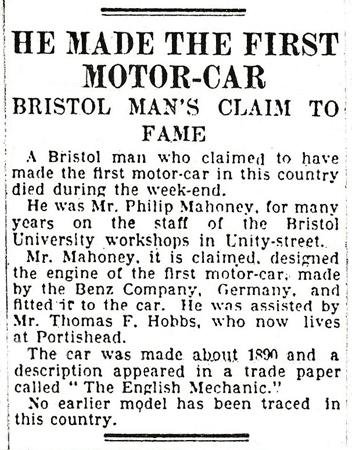
Bristol Evening World of January 7th, 1935
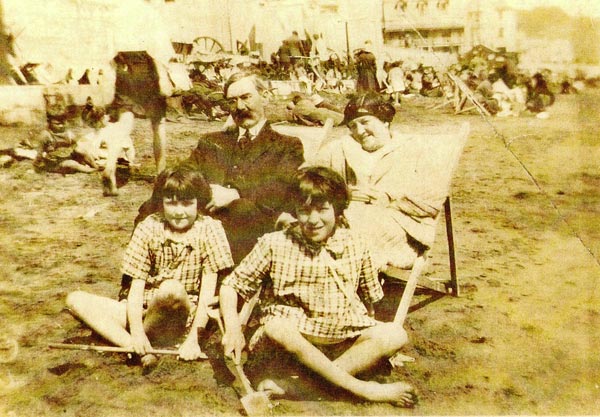
Philip Mahoney is seen here with Catherine, his wife and two the youngest of his nine children
In January 2013, I received and email from Julian who helps with the History For You and Temple Local History Group of Bristol (Internet Archive). A family named Mahoney had a place in Stapleton Road specialising in clock and jewellers sundries. I used to use them when they were in Temple House, on temple Way, I believe they moved to Stapleton Road when Temple fell prey to the developers.
Maple Leaf Coaches
Original query from Derek
Derek would like to know if anyone have any information or photographs of the garage in Clifton Road, Clifton which was used by Maple Leaf Coaches. They were there from the 1920s until 1970s.
Reply from Ray
I don't know anything at all about this company but they appear to have been eventually taken over by Wessex Coaches. That company has had a history published by John Sealey that does mention Maple Leaf Coaches. The book is relatively new being published in 2013, and so Google omits a great deal from it. The book is called The History of Wessex Coaches: A Company With Two Faces and is available from Amazon.
I did also manage to find a mention of the company on an online copy of the 2nd July 1929 edition of Wheels of Industry. That says:
A Strenuous Test for the Star Flyer
W. J. Bence and Sons, Ltd., a well known West of England coach building concern, which was founded 40 years ago, has for some time been acting as a distributor in the western area for the Star Flyer chassis. To display the capabilities of this particular model the company recently arranged a demonstration with a bus, when a full complement of passengers was carried up Porlock Hill, which in places has a gradient of 1 in 4. The trial was witnessed by a number of well-known coach and motorbus proprietors, including Mr. L. W. Andrews (Clifton Greys), Mr. R. H. Burrow (Maid of the Mountains), Mr. T. Coles (Portishead), Messrs. Ford and Sons (Miriehead), Mr. A. G. Gough (Gough's Garages, Ltd.), Mr. W. H. Moon and Mr. Hill (Guy Motors, Ltd., and the Star Motor Co., Ltd.), Mr. C. W. Jordan (Maple Leaf Coaches), Mr. M. Miles (National Omnibus Co.), and Messrs. Russett Brothers (Pioneer Transport, Ltd.).
Martin, Parker, Thomas and Bailey Families
Original query from Wendy
Wendy is looking for details of Henry Martin (born about 1851 at St Philips) and married Amelia Eliza Wright (nee Pinker a widow) in December 1875 at Bedminster Register Office, they had a son in 1879, Henry Parker Martin who was brought up by his aunt and uncle (Perrot or Peverall) from the age of 9 at Osborne Street, Southville, after his mother died.
Also Henry Parker who married Mary Ann Pinker both born about 1817 (he was a cooper and lived at Mill Lane - somewhere along the line I think there is a connection to piano makers)
Also George Thomas who had a son George Christopher Thomas. Also Harriet Bailey who married George Christopher Thomas in April 1877 (her father was shown to be a hawker on her marriage certificate)
Reply from Ray
Wendy also asked where people would be buried before the building of Arno's Vale Cemetery. Arno's Vale was established by an Act of Parliament in 1837. Its first burial was in 1839 and by the end of the century around 96,000 burials had taken place. For a history of the cemetery see the Arno's Vale site. Before Arno's Vale people would have been buried in one of the churchyards around the city. These were becoming overcrowded, hence the need for the massive cemetery in Brislington.
E. N . Miles
Original query from Karen
Karen says that she has been looking for information on E N Miles's the haberdashery that used to be in Canon Street, opposite the London Inn. She recalls what a wonderful shop it was.
Reply from Carole
Carole writes, "They used to give a farthings worth of dressmaking pins instead of a farthing! I was told don't take the "pins" when I went shopping for my mother and grandmother!"
Mortimer House, Clifton
Original query from Keith
Keith would like information and old photographs of Mortimer House?
Reply from Ray
From The Hart-Davis Family, Mortimer House was once home to William Hart Davis who was born in Bristol on 8th June 1766. Between 1807 and 1812 he was the MP for Colchester. He died in Hampstead on 21st February 1842 and was buried in Kensal Green Cemetery, London.
Pigot's Directory says that in 1830 the house was home to Harford Battersby.
Apparently there is a photograph of the house taken in the 1920's by Gerald Sanville, but I've been unable to find a copy of it.
Nelson Street
Original query from Suzanne
Suzanne is doing a bit of research and is trying to find out what stood in Nelson Street in 1842 and did it have any Dutch connections?
Reply from Ray
I can't find much out about this myself. The only things I've come across is that a Diocesan School was founded there in 1831. UWE The Redland Papers (Internet Archive). I also came across a photograph in Reece Winstone's "Bristol in the 1880's. This shows Nelson Street looking towards Broadmead on 9th March 1889, the day of the Bristol Flood.
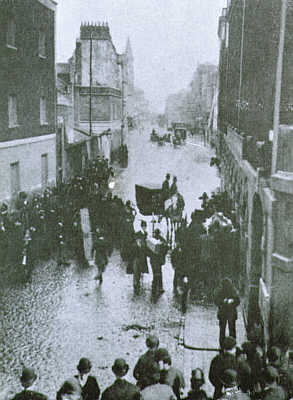
Nelson Street - 9th March 1889
On the right is Duck Lane - now Fairfax Street. The buildings on the left are where the Bridewell Police station is now.
New Cut
Original query from my mate Will, Totterdown, Bristol
On these pages you'll find the New Cut mentioned numerous times. Although I know who designed it and when it was built, Will wants to know some of the more social history about it. We'd like to know how many men were employed in its construction, how they lived, how they did the work and what happened to them after it was finished.
Newfoundland, Bristol's Hope, John Guy and William Colston
Original query from Fred
Fred is the Membership Secretary of the Old Colstonian Society, for past pupils of Colstons School, Stapleton, Bristol, founded by Edward Colston. He was contacted by the Cupids Cove (Cupers Cove) Historical Society who are researching details of the voyage of John Guy in 1610, to settle in Newfoundland.
Reply from Ray
From "Merchants and Merchandise in Seventeenth Century Bristol" by Patrick McGrath (Bristol Record Society publication Volume XIX, 1955)
William Colston was Edward's father
William colston was one of the people implicated when Robert Yeamans and George Bowcher tried to open the City to Prince Rupert during the civil War. Whatever happened, William was made councillor in 1643. He was actually a bit more than that, he was Sheriff (1643 - 1644), Warden of the Merchant Venturers (1643 - 1644), Alderman (1662 - 1664)
On 10th May 1636, William Colston was in court "for not causinge a grate to bee sett before his seller dore beinge dangerous."
On 19th April 1637, William Colston's daughter, Margarett, married another merchant, William Hobson.
On 10th March 1658, 5 tons of "Province oyle" was captured from one of William's ships by the Spanish.
The "Zannt" carried 90 ferkins of butter belonging to William to Cadiz.
William Colston died on 21st November 1681, aged 73.
The earliest mention of John Guy, appears in the 1609 will of John Fowens. John Guy received 20 shillings of gold and "as much fine blacke Clothe as will make ... a gowne."
Patrick McGrath also wrote "The Merchant Venturers of Bristol" (Society of Merchant Venturers, 1975)
It seems the Merchant Venturers didn't officially unertake or sponsor voyages of discovery, colonization or exploration. McGrath says this (page 85) "It [The Merchant Venturers Society] does not seem to have to have given any official backing to two of its members, Thomas Hopkins and Tomas Aldworth, when they were appointed by the Mayor [of Bristol] in 1606 to confer with the inhabitants of Bristol about the development of Virginia, not to the plantation which another member, John Guy, made in Newfoundland. The Society's first "Book of Charters" records that in 1617-1618 "Divers particular merchantes of this Society Did sett Forwardes the plantacion of a porcion of land in the Country of Newfoundland called Bristolles Hope", but the Society itself was not involved."
This is from page 531. "In 1909, it [the Society] received a letter from the Lord Mayor stating that the Historical Society of Newfoundland was raising a subscription in order to erect a memorial to John Guy. The Lord Mayor was proposing to inform "the Colonists" that the city would contribute £50 and he invited the Society to make a donation. It was agreed to give £100, provided the whole amount was collected before the end of 1910."
I've also got a copy of "The Annals of Bristol in the Seventeenth Century" by John Latimer (William George's Sons, 1900)
In April 1606, James I authorized the foundation of two colonies in Virginia. A subscription to the scheme in Bristol was raised and the Mayor, Thomas James, promised £13 6s 8d annually for 5 years, as did John Guy who was sheriff.
"The reports made by Martin Pring and other explorers as to the climate and resources of North America aroused a strong desire in Bristol and other ports to promote colonization. In February, 1609, an application was made to the Privy Council for leave to found a plantation in Newfoundland, in a district uninhabited by Christians, the promoters being a number of merchants in London and Bristol. The King in the following year granted a patent to the Earl of Northampton, Sir Francis Bacon, and a great many others (the Bristol beneficiaries included Matthew Haviland, Thomas Aldworth, William Lewes, John Guy, Richard Holworthy, John Langton, Humphry Hooke, Philip Guy, William Meredith, Adrian Jennings, and John Doughty), establishing an incorporation styled the "Company of Adventurers and Planters of London and Bristol for the colony or plantation of Newfoundland in the southern and eastern parts."
John Guy, an eminent local merchant, was appointed the first governor of this body, and his heart was thoroughly in the enterprise. Three ships having been equipped, the governor, with his brother, Philip Guy, his brother-in-law, William Colston, and thirty-nine emigrants of both sexes, embarked, a store of live cattle, goats, poultry, etc., was put on board, and the vessels left Bristol early in May, 1610, arriving at their destination in twenty-three days, when a landing was made at a little landlocked harbour called Cupids. The emigrants forthwith began the erection of dwellings, storehouses, wharves, and a fort defended by a stockade, while Guy built himself a mansion, called Sea Forest House. Guy returned to Bristol in the autumn of 1611, leaving his brother deputy-governor, but sailed again for the island in the following year, accompanied by a clergyman and several more emigrants. After his final return to England, William Colston was deputy-governor in 1613-14. The settlement, however, was not a permanentsuccess. By his will, dated in February, 1626, Mr. Guy left his Sea Forest estate to his four sons, then under age, but the historians of Newfoundland have found no record of the colony after 1628."
William Colston lived in Wine Street, Bristol from his marriage to his death, a period of 50 years.
I've also got a copy of "Bristol Past and Present" (3 volumes) by J. F. Nicholls and John Taylor (Arrowsmith, 1881) Volume 1 contains...
"Mr. John Guy deserves honourable mention on account of his enterprising spirit. He twice represented the city in Parliament, in 1620 and 1623.
"In a MS. penes me," says Barrett, "one Mr. Guy, in 1609, took out a number of persons of both sexes, designing to form a settlement all the winter in Newfoundland. He was a member of the common council of Bristol, and mayor in 1618. He procured a charter and license of the king (James) for his intended plantation, having some rich merchants of London, as well as Bristol, joined with him for the better and more effectual prosecuting of the scheme. Many of this city did advance money towards it; and so Mr. Guy, with some other young merchants, being fitted out with more men and all necessaries, took shipping here for Newfoundland, to make a trial of the place by staying there all the winter."
In Stow's Chronicle, continued by E. Howes, at 943, we have a very particular relation of this voyage? "After the patent was obtained, and several noblemen, gentlemen and citizens being thereby made a body corporate by the name of the treasurer and company of adventurers and planters of the cities of London and Bristol, for the colony and plantation of Newfoundland, in the southern and eastern parts, lying between the degrees 52 and 46, the company sent ships with men, women, and all necessaries thither, and ordained Maister John Guy, a citizen of Bristol, a man very industrious and of good experience, to be their general in this plantation, who planted a colony of men and women in the island of Newfoundland (which was first discovered by Sebastian Cabot, and ever since yearly frequented by the English in fishing time); with them, also, they, for their use to increase there, transported hennes, ducks, pigeons, conies, goats, kine, and other live creatures, all which did very well there. This General Guy stayed there with the colony both winter and summer, whose natures and conditions in general agreed very well with the soil and clyme. In this plantation there were sent none hut men of civill lyfe, and of some honest trade or profession, by which course they lived and prospered the better. Since the date of their charter (8 James I., 2nd May, 1610) they have sent yearly supplies thither unto the year 1614, Master John Slaney, Esq., being their first treasurer."
"1611. Mr. John Guy, with a preacher and several men and women, returned to Newfoundland to his son."
Peacock Family
Original query from Jeff
Jeff is researching the Peacock family tree. He used to live at 37, Bell Hill which was next door to Billy Grays wet fish shop & various members of his family lived at other houses on the same road. Jeff is also interested in other roads in the area such as Belle Vue Terrace & Milsoms Barton. The family grave in Weslyan Church in Kingswood is now behind barriers ready for redevelopment and Jeff is having a difficult time even getting access to this let alone finding any information about the members of the family buried there.
Reply from Anita
Anita emailed to say that her great grandparents were Albert Peacock and Eliza Anne Peacock an that "Mike" who looks after the church records at the Methodist Church in Kingswood has a list of the people buried at the Weslyan Church in Kingswood. Apparently they often get people asking about "who is buried in the deralict Weslyan church.". The Methodist Church in Kingswood have their own website with contact information.
Pickford Family
Original query from Denise
Denise is researching the Pickford family and saw the article on this page entitled "Frampton, Jones and Bowyer Families". In that I said that Jedediah Pickford was one of those accused of customs fraud in November 1691. Denise says that he was born in Macclesfield, Cheshire. She would be very interested in anything else anyone can tell her about the Pickfords in Bristol.
If you have any information we'd be grateful if you could email me at or Denise directly.
Police
Original query from Steve
I believe New Bridewell police station was built in 1928, but was the main city police station before it in the same place? Also I'm trying to get to grips with the structure of rank back in the 20's, was there such a thing as CID?
Reply from Ray
I'd have thought that something like this would be easy to find, but it isn't. One online source of information is the Railway Police Forces site (Internet Archive). This says the GWR force had CID and detectives at least in 1939. The history page of the Avon and Somerset Police (Internet Archive) is very sparse. I did however discover that many police records can be found in Kingsweston House in Napier Miles Road and the Bristol Public Records Office. The booklet by Roderick Walters. "The Establishment of the Bristol Police Force" and published by the Bristol Branch of the Historical Association, unfortunately, doesn't contain much that is useful to Steve as the period it covers ends in 1850.
Addendum by Ray
I've been doing some more research, this comes from "Bristol's History", by Charles Wells and Reece Winstone (Reece Winstone, 1966) There was a centuries old passageway in the vicinity of Wine Street and Mary-le-Port Street known as Guard House Passage. This was ordered closed by the City Council in April 1880. This passage seems to have been quite ancient as it was formerly known as Swan Lane in the time of William Wyrcestre (or Worcester) who died in 1482. It is unknown when the Guard House was built at the Wine Street end, but the "Main Guard" was billeted there during the Civil War (1642-3). This was the building that Boucher and Yeamans (or Yeomans) planned to capture before they were caught and hanged (See Bristol - 1650 Onwards). In 1681 it was owned by Robert Yate, who may be related to William Yate who was elected Mayor in 1596 and who owned the Gateway in Guard House Passage. In the eighteenth and nineteenth centuries the Guard House was used as a lock-up for those guilty of breaching the peace or theft. When the police were reorganized in 1836, the building became the central police station. In 1844 a new station was built in Bridewell Street. As Steve says, this station lasted until 1928 when the new station was built. Time hadn't finished with the Guard House yet though. When the City Council closed Guard House Passage in 1880, they allowed the Guard House to be rebuilt by Jones & Co. as 56 and 57 Wine Street and used as a shop.
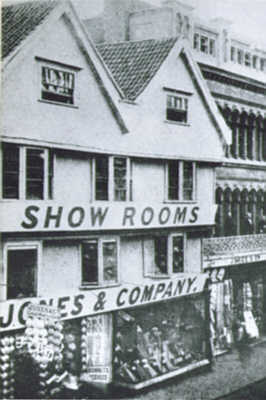
This is what the Guard House looked like.
(from "Bristol As It Was 1879-1874", Reece Winstone, 1968, plate 18)
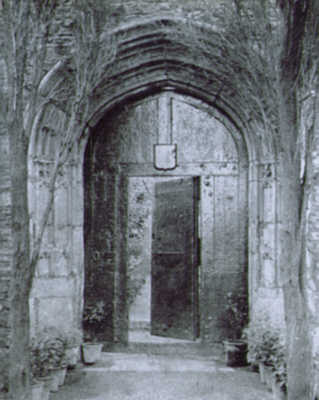
The Guard House Doorway - 1881
In 1571, it was the entrance to William Yate's (Mayor of Bristol, 1796) mansion
In 1805, it was the Guard House
Between 1836 and 1844 it was the first police station
In 1881, during rebuilding by Jones & Co., the doorway was moved to Bishopston
(where this photograph was taken)
From 1908 onwards it has been in the care of the City Museum and Art Gallery.
(from "Bristol in the 1880's", Reece Winstone, 1978, plate 27)
You'll notice some discrepancy in the dates for when the Guard House was rebuilt and the doorway removed. In "Bristol As It Was 1879-1874" the photograph does not show the doorway, but according to Wells and "Bristol in the 1880's", it wasn't removed until sometime around 1880.
Popes of Bristol
Original query from Robert
Has anyone any information about Richard Pope of Bristol who was a soap maker? He had five sons, John, Thomas, William, Richard Jr., and Nathanial. He was born about 1590 and died in back in Bristol around 1652.
I've been able to find a little about this family. John Pope was the son of Michael Pope, soapmaker, to whom he was apprenticed in 1630. He became a burgess in 1637. He was Sheriff in 1653-1654 and became a Merchant Venturer in 1657. He declined the office of Mayor in 1663. He died 11th February 1667. John Pope was an eighth part owner of a ship called the Endeavour of about 200 tons.
Between 1654 and 1694, a John and Michael Pope imported 6,550 hogsheads of Muscovado and white sugar. This was more than any other importer. A hogshead was a unit of volume and could hold 63 gallons.
Richard Pope seems to have been involved in the tobacco business around 1679.
Reply from Susan
Susan is doing her own research into Elizabeth Ham, who was born in 1783 and whose mother, Elizabeth Pope lived in Brislington. I've put Robert and Susan in contact with each other, hopefully they'll have information beneficial to both.
Post Codes
Original query from Alan
Alan writes, "my main question would be what year (about ) did they bring in postal codes in Bristol?"
Reply from Ray
The numbering of postal districts (Knowle as BS4, Bedminster as B3 and so on) was first proposed by the Royal Mail in 1931, and was put into effect the following year. The post codes as we know them today, BS3 4JZ for example, were introduced in the 1960's and was complete by 1974.
POW Camps
I had several requests for information about POW camps in and around Bristol and so I added what I have discovered on the Bristol Blitz page. If anyone has anything to add please contact me.
Ma Pugsley, the Civil War and a well
I had several requests for information about Ma Pugsley and so I created a page from what I discovered. If anyone has anything to add please contact me.
Purdown
Original query from Faye
Purdown is in danger of redevelopment. Faye is trying to co-ordinate a campaign to save Purdown from development and would like to collate as much information about this area as possible. She'd like to know the areas history and what organisations exist in the area with an interest in keeping the area green.
Raymond Kaye Orchestra
Original query from Brenda
Brenda is looking for information about her dad's dance band, from Weston-super-Mare. He was in the Raymond Kaye Orchestra, and I found out that they won the Melody Maker Regional dance band final in 1953. This lead to them having a 6 week residency in South Baths, Bristol at the invitation of Eric Winstone.
Reply from Ray
I think the South Baths you're referring to wasn't a night club at all, but literally a swimming pool! It was South Bristol Swimming Baths in Dean Lane, Bedminster, Bristol. The place has an interesting history. When I was very young they had things like dolphin shows in the pool. They used to board the pool over and it would become a venue for bands and dancing. It was also used for roller skating.
A piece about the Raymond Kaye Orchestra is on the The National Jazz Archive, dated October 1953, that says "Raymond Kaye Orchestra, of Weston-super-Mare, win the M M West Regional Dance Band Area Final and are booked by Eric Winstone for a six-week season at South Baths, Bristol."
The Eyes Of Blond band web site says that band played at Newton Park College, Bath on Saturday, December 06, 1969, supporting Simon Dupree and the Big Sound and that the Raymond Kaye Quartet and Tom Browne also played.
In 2008, the Bristol Evenng Post carried a story about the Ashton Court Country Club in the 1970s, and that said that dance music was provided by The Olympics, Les Drake Trio, the Raymond Kaye Quartet, and the Blue Diamonds.
According to the 1972 program for the National Rob Walker Trophy Scramble, Frome, their agent was Fi-Sounds Entertainments of 17 Bath Street, Frome. Interestingly the Raymond Kaye Orchestra is listed first, the others being The Checkmates, The Squads, Ray Cox Band, Decimal Point Five, and Bernard Emm and his Orchestra.
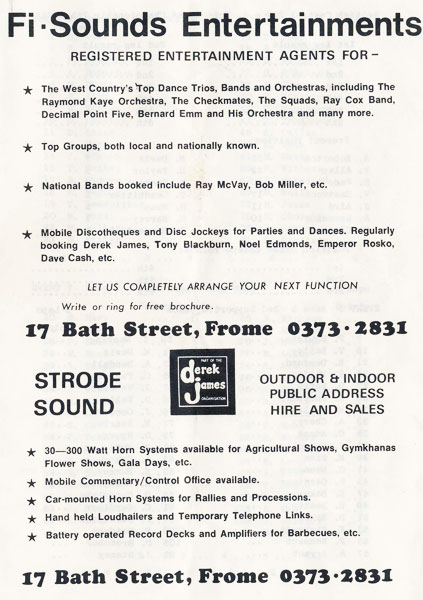
Roach's
Original query from Dave
Dave writes, "My Grandfather by the family name Roach lived in Hotwells, Bristol and died in July 1963. He was well know in the area as being a scavenger and he used to walk the river at low tide and pick up various objects discarded by merchant vessels and was up the river. He also used to have the sole rights to fish for Salmon which he would send his daughter (Mary Roach died in 2002. My grandmother preferred to be called Bo Bo for some unknown reason) to the hotels selling them. He was often called upon to retrieve the bodies from the river Avon (often the suicides from the Clifton suspension bridge) as he knew the currents and where to look, he was once called upon to retrieve a very noble woman believed to be from one of the aristocracy families or even royalty living in the Bristol area that committed suicide from the bridge. It was believed that the search had taken place for around a week before they asked his advice, then they were able to recover the body in a few hours of searching. I should also point out being the type of man he was that in most cases the bodies were discovered on the Avon side of the river as they paid him 2 crowns instead of the Somerset side that only paid 1 crown per body. In their time the Roach family had a very strong presence in the Area and my grandfather having a larger than life character, my aunt is still living in one of the houses virtually underneath the Clifton suspension bridge, My grandmother lived in one of the 3-4 story house in Hotwells itself (just past the flyover and at the back of the pub (White horse, I think now). Anyways getting back to the original story it is said that when the BBC abandoned the Cliff Railway my grandfather brought the rights to it, he also purchased the old steam tunnel on the other side of the river which is now practically collapsed and blocked at both ends. There has always been rumors that these tunnels were storage for all the ?junk' he collected and if his 2 garden shed located at the rear of his Hotwells property indicated then there would be a wealth of historical or even valuable stuff in these locations.
At one time he also purchased the many house boats located near the docks but like most of the things this family have done over the years it became a head ache as the Bristol council decided to stop the practice of house boat living by increasing the taxes to high levels, forcing most of the house boats to leave or be destroyed.
I didn't get a chance to meet my Granddad he sadly died 2 years before I was born and the day coincided with my brother's birth. There are still a few Roach families in the area, My aunty being Marion Roach a semi famous dress designer who incidentally now owns the property my grandfather used to own in Hotwells.
I would like to know if anyone has any further information about my grandfather, his life and if he still has the rights or ownership on the old railway tunnel, I am pretty sure the old Cliff railway now has other owners, but it would be nice to find out how much of this story is true and more to the point how well remembered he was!!
Robinsons of Bristol
I had several requests for information about A. S. & A. Robinsons and so I created a page from what I discovered. If anyone has anything to add please contact me.
St. Andrews
Original query from John, St. Andrews, Bristol
Ashley Court Villas, which I am told was built on the site of the old Mansion House. This was owned (possibly built) by a Sir Humphrey Hooke and was demolished in 1835 apparently after a fire. A lot of the stone was recycled to build 5 four storey houses. There is a communal garden in front of the Houses with two huge pillars with Lions on top. These were the original Gates posts of the old house and have dates carved into them dating from 1746. (this may be fake of course, but it must have taken some time to carve it into stone!) Is there any information that you could give me re the mansion house?
St. Annes
Original query from Josephine
A bit of an unusual request from Josephine. She writes, "I am un-happy, and ill at ease when I am over that way, I can't wait to get out of the place, and I would just like to know what went on over there in past years."
Reply from Ray
Ken Taylor's book, "Brislington Ghosts and Legends" contains the legend of St. Anne's well. The site is a medieval shrine and holy well (Internet Archive).
St. George
Original query from Dan
Dan would like to know something of the history of St. George, especially the mines and the old tin church near St. Aidens.
St. George: Schools, Ophanages and Other Institutions
Original query from Geoff
Geoff wants to know if a history of St. George school was written.
Original query from Liz
Lize is researching her family history and would like information on the school that was at 34 or 36 Summerhill Road. Also anything about Violet and Lavander Williams who attended the school.
Reply from Ray
There were several schools on Summerhill Road and surrounding district. I would like to hear from anyone who has any information about the schools, orphanages or other institutions in the area.
St. George’s House, 101 St. George’s Road, St. Augustine’s
Original query from Liz
Liz is researching her family history and says a relative was married to a John Edward Whittington Jones who lived at 101 St. George’s Road, St. Augustine’s, Bristol in 1903. She found St. George’s House at this address and ask about the history of that house, now used as a shelter. In 1903, was it a private dwelling or something else?
Reply from Ray

St. George's House, St. George’s Road, St. Augustine’s
Image from Google Maps
St. George's House is now a young people support centre offering short-term emergency accommodation for 16 to 21-year olds.
I created a new page with everything I could find about St. George's House, if you know more, then please let me know.
St. Nicholas Church
Original query from Vernon Denford, Gladysdale, Victoria, Australia
I was born (1938) in Princess St, Bedminster (now demolished) later lived in Mendip Rd and first marriage years in the Chessels before migrating to Australia. Bedminster primary school, a short stint at St Mary Redcliffe Secondary, formative years at Bristol Tech (building).
In the late 40s early fifties I was in the choir at St Nicholas church (do you know about the relocation of the cemetery in High St. and now (or then in the 40s & 50s) the skeleton remains were in the cellar under High St accessible from a door behind the altar in the St Nicholas' Crypt) We had lots of fun secretly scaring the junior members of the choir by taking them into the crypt behind the altar. Rows and rows of skulls on steel shelving and reputably the stone coffin of a very young girl. The vicar was the Rev. John Stancomb but I can't remember the name of the organist choir master. Does anyone remember his name? We would get paid every three months, at the rate of 2 shilling and 6 pence a month and a shilling for a wedding.
If anyone has any information on St. Nicholas Church we'd be grateful if you could contact me at If you prefer to email Vernon directly his email address is denford@foxall.com.au
Reply from Bob
I was intrigued to read the description of the skulls and bones in the crypt of St. Nicholas Church. I too have seen these remains and when I relate the facts to others, I can see that they regard the whole affair as a bit of a tall story.
The skulls are numbered with large copperplate numbers. I was told that when Baldwin Street was built in Victorian times, the contents of the tombs disturbed, were re-allocated in the crypt and the details noted. There must be a book somewhere recording the names against the numbers on the skulls, unless it was destroyed in the blitz.
Another intriguing fact is that the skulls have a large hole on the top of the cranium. There are two schools of thought regarding this. One is that the spirit was released in this way, the other and probably more likely is that in an age when people were often buried alive due to wrong diagnosis, it was a surefire way of assuring that they were in fact deceased.
For those interested in dentistry, the teeth and especially the lower molars are interesting. Apart from an almost complete lack of decay, the teeth are ground flat due to either sandstone from the grinding wheel contaminating the flour and subsequently the bread, or that the poor devoured every scrap of meat they were fortunate enough to obtain, bones and all.
St. Peter's Hospital
Original query from Karen
Karen is trying to find the records of the old hospital, workhouse and insane asylum.
Built in 1402 as a house this magnificent building was at various times, a sugar refinery, mint, school, workhouse, lunatic asylum and offices. It was destroyed during the Blitz on Sunday, 24th November, 1940.
Saville Cottage, Clifton and the Paul Family
Original query from Fiona
I'm tracing my family tree and am interested in any info on the Paul family who were wine merchants in Clifton Bristol. They lived at Saville cottage. Can any one tell me any thing about Saville cottage.
Reply from Ray
The only thing I've been able to find about Saville cottage is from Pigot's Directory of 1830 which says that it was used by Joseph Emmett Norton who was a Wine & Spirit Merchant.
Sayers - Father Murdered by Son
Original query from Andrea
Andrea sent this intriguing email - I am looking for information on a murder that happened in 1937. It happened in Cabot Street, Saint Paul's. A Mr. George Sayers was killed by his son Mr. Frederick Sayers. They are supposed to be related to me, but I can't find any reports of this crime.
Richard Burke Sedwick & Anna Vaughan
Original query from Christel
Christel is looking for information on the daguerreotypist and ambrotypist Richard Burke Sedwick from Bristol. Born in 1828, he died in 1860 aged 32. He may have worked for a time in St. Thomas. His mother's name was Anna Vaughan. When he died his inventory shows a lot of photographic material, among it two cameras obscuras, portraits and frames.
Slave Captains
Original query from Mick
Mick writes, "I'm trying to find out some information on slave trader captains. One of my ancestors called Banyard used to sail to Africa and the West Indies." James Banyard was married to a Elizabeth Hawkins.
My Reply
This information is harder to come by than the names of the ship owners and their agents. The agents were the people responsible for outfitting the ships, making the arrangements for the supply and selling of slaves and so on. Here's a list of agents, 1698 - 1807, that comes from the booklet "The Bristol Slave Traders" by David Richardson (Bristol Branch of the Historical Association, 1985)
| Name | Voyages Managed |
Period | Name | Voyages Managed |
Period |
| Anderson, Charles | 16 | 1797 - 1805 | Hobhouse, Isaac | 44 | 1722 - 1747 |
| Anderson, John | 66 | 1764 - 1797 | Hooke, Abraham | 23 | 1702 - 1727 |
| Becher, John | 28 | 1711 - 1732 | Iles, Joseph | 19 | 1720 - 1750 |
| Becher, Michael | 25 | 1727 - 1752 | Jacob, Samuel | 40 | 1716 - 1747 |
| Bright, Henry | 21 | 1749 - 1766 | Jefferis, Joseph | 12 | 1717 - 1734 |
| Challoner, William | 13 | 1714 - 1726 | Jefferis, William | 34 | 1713 - 1747 |
| Chilcott, John | 12 | 1770 - 1777 | Jenkins, Walter | 11 | 1732 - 1741 |
| Coghlan, John | 10 | 1759 - 1781 | Jones, James | 68 | 1783 - 1795 |
| Cross, John | 16 | 1737 - 1747 | Jones, Thomas | 34 | 1767 - 1794 |
| Dampier, Henry | 34 | 1727 - 1744 | Laroche, James | 132 | 1728 - 1769 |
| Day, James | 56 | 1711 - 1742 | Lougher, Richard & Walter | 15 | 1725 - 1745 |
| Day, Peter | 20 | 1711 - 1734 | Lougher, Walter | 34 | 1732 - 1760 |
| Deane, Thomas | 40 | 1747 - 1764 | McTaggart, James | 14 | 1771 - 1787 |
| Dolman, Thomas | 11 | 1714 - 1730 | Pennington, Thomas | 13 | 1734 - 1749 |
| Duckinfield, John | 23 | 1714 - 1730 | Powell, John | 58 | 1755 - 1776 |
| Farr, Richard | 37 | 1726 - 1745 | Power, Thomas | 13 | 1734 - 1748 |
| Farr, Richard, Jnr. | 20 | 1747 - 1772 | Rogers, Francis | 10 | 1700 - 1714 |
| Fowler, John | 77 | 1758 - 1777 | Rogers, James | 51 | 1783 - 1792 |
| Freke, Thomas | 14 | 1716 - 1731 | Ruddock, Noblet | 30 | 1712 - 1725 |
| Gordon, Robert | 14 | 1751 - 1767 | Rumsey, James | 20 | 1753 - 1762 |
| Gordon, William | 25 | 1729 - 1757 | Saunders, Edmund | 32 | 1723 - 1739 |
| Grant, Abel | 14 | 1721 - 1743 | Scandret, Charles & Christopher | 10 | 1729 - 1738 |
| Hamilton, David | 28 | 1766 - 1778 | Sims, Thomas | 25 | 1763 - 1772 |
| Hare, William | 38 | 1729 - 1752 | Tonge, Henry | 42 | 1730 - 1753 |
| Harris, Philip | 16 | 1715 - 1726 | Tunbridge, Robert | 18 | 1708 - 1721 |
| Henvil, Richard | 30 | 1709 - 1744 | Way, Joseph | 17 | 1702 - 1720 |
The list above is of the agents, most of whom seemed to have invested in the voyages. Many of the major merchants are not on the list, people like Edward Colston, the Pinney family and so on. The list does however, contain the names of some captains who became investors themselves. This includes people like John Anderson, John Chilcott, John Fowler, David Hamilton, James McTaggart and Edmund Saunders. Even the usually excellent Latimer's Annals only gives generalities such as "the captain of Princess of Orange" but doesn't give his name.
John Albert Ernest Smith
Original query from Erica, Bristol
Erica writes, "My Grandfather, John Albert Ernest Smith was born in Bristol and was a Master Tailor working from home at 1 Bruton Place, Clifton (used to be called Park House) situated next door to the Pro-Cathedral. He served in WW1 even though he had been exempt from service due to his trade. My grandmother, Eliza Matilda Smith nee Rolph, was born in Cardiff. They married in June 1900. One of the family memories concerning my grandfather was that he was the tailor to the Lord Mayor of Bristol, Herbert Ashman, and also to the famous W. G. Grace.
I have copies of some old photographs, which we cannot identify. One is of a bellboy at the Clifton Hotel. So if anyone can help us identify this, it could help us identify another unnamed photograph of a WW1 soldier and his family."
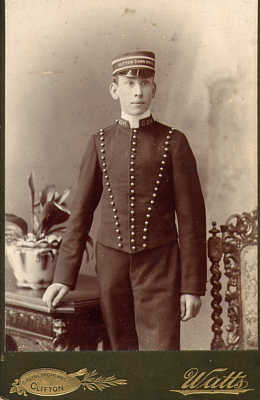
Spiller
Original query from Jason and Sarah
Jason and Sarah are doing some family research and are looking for information on either James or Eliza Spiller. They were both born in Taunton Somerset around 1835 and Eliza was born Warren. They are very baffled by the fact that they are both registered in the GRO Death indexes for Bristol 1882. On the record they have it shows death as being in Barton Regis but they lived Grovesnor Place in 1881. We know that this must be right as we have a copy of the 1891 Census sheet which shows one of their daughters in Mullers Orphanage aged 14. James and Eliza are both registered as dead in March of 1882 so they must have died either together or very close together but we are not sure which and are trying to unravel the mystery.
My Reply
Perhaps you mean Grosvenor Place rather than Grovesnor Place? Barton Regis could be used instead of Clifton in Bristol. This sometimes confuses people. Historically, Bristol was divided into three Registration Districts. These were Bristol, Bedminster and Clifton or Barton Regis. Clifton and Barton Regis were different names for the same district. This district was called Clifton from 1837 to 1875 and then became Barton Regis from 1875 to 1898. In 1899 onwards, all three districts came under the Registration district of Bristol.
I first thought of one of the cholera epidemics, but the dates are wrong. The main epidemics in Britain in general and Bristol in particular were in 1831-2, 1848-9, 1853-4 and 1865-6 (from Scenta (Internet Archive)).
Other than that, perhaps some of the genealogical sites listed on my Links page may be able to help you.
Stickland Fry
Original query from Graham, Canada
My great grandfather was buried there in August 1915, but wondered if there was a website to look up information on individuals buried there. I'm not sure whether he had a tomb stone or what the records show as far as who his parents were. His name was John William Stickland Fry and his wife was Emma Fry (nee Worner or Warner). Emma is buried here in Canada. John was born in 1855 or thereabouts.
My Reply
So far as I know there isn't a website to look up the records of Arno's Vale Cemetery. But, there is a website about Arnos Vale that may be able to help.
Strachan & Henshaw
Original query from Bryan
I was apprenticed at Strachan & Henshaw the old Whitehall works in Chalks road and started there in 1947. I mention this because they were part of the ES and A Robinson Group and made envelope and bag making machines etc. Part of my apprenticeship was spent at the Fishponds Wax Paper works and another part ay Colodense and the Cardboard Box factory in Bedminster West Street. I wonder of there are any other of the apprentices still around the Bristol area?
My Reply
For anyone interested in the history of this company the following appears in "Bristol & Co." by Helen Reid (Redcliffe Press, 1987, ISBN 0-948265-61-2)
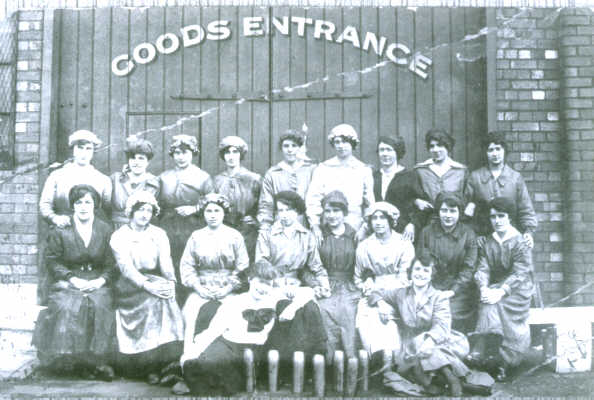
Strachan & Henshaw - Women Munition Workers during WWI
The shifts were arranged so the women never met the male employees.
Strachan and Henshaw, founded in 1879 by Robert Price Strachan, an Irishman, and George Henshaw, started in the shadow of the E.S. and A. Robinson factory, which probably explains why right from the beginning, the firm was interested in paper-bag making machines. Both men were apprentices of Hodge, an engineer in Thomas Street and builder of the satchel bag-making machine for Robinsons.
The pair started in a converted house in Long Row, off Victoria Street, making appliances connected with the paper bag and printing trades, and also became efficient general engineers. In 1890 they moved to Lewin's Mead; they needed the space because the old house was so crowded that machinery parts had to be assembled in the street. About this time they developed a rotary stereo printing machine capable of printing paper bags during the process of manufacture, and these machines made them an international reputation: they sold them in Russia, Scandinavia, Italy, Rumania, France, Turkey and Australia.
Strachan and Henshaw also got the contract to install power and power distribution for the great Bristol Industrial Exhibition in St. Augustine's Parade in 1893, and in the 1890s they also got involved in work for the new electric tramways system being set up in the city. This resulted in another contract for tramways work, in South America.
In 1904 the firm moved to its present site at Whitehall, and developed some new lines in goods hoists, water pumps and electric transporters. Then came the war and normal production virtually ceased, because the company became a munitions factory, making shells and gun parts. Girls were taken on for the first time ever, and great care was taken to stagger their shifts with the men's, so that the two sexes never met.
Early in 1920, E.S. and A. Robinson acquired the whole business, and Strachan followed Henshaw into retirement. The new owners stimulated research into more sophisticated colour-printing paper-bag machines, and, just before the Second World War, the firm had great hopes of selling in Russia - they had even printed a catalogue in Russian (by the Thirties, their catalogues were always tri-lingual) - but the Russians never saw them. Other memories of the Thirties include a spirited black horse which pulled the delivery cart, men working by the light of naked gas flames, and a ship's bell that signalled breaks, met with cries of "Smoko!".
But in 1940, once again, the firm went over to war work, which included the development of equipment for field survey units, gun carriages, and launching rigs; they made submarine-detecting apparatus and torpedo parts, fuse machines, anti-aircraft shells, and trench mortar bombs. During the war the firm also made a giant railway-truck tipper, 120 feet tall and so large that neighbours living in Whitehall feared that enemy pilots would use it as a target. The firm had to charter a plane to fly over and take aerial photographs to make sure it was invisible.
Girls had not been allowed to work in the plant between the wars, but they came back again in 1940, and even worked night shifts - once again staggered for propriety's sake! In 1958, the old Central Engineering Works in Lewin's Mead was closed after 68 years; in 1968 came the Queen's Award for Industry, and in 1979 the firm celebrated its centenary with a big day out at Dodington, with a bumper garden party, bands and a centenary mug.
Fay Taylour
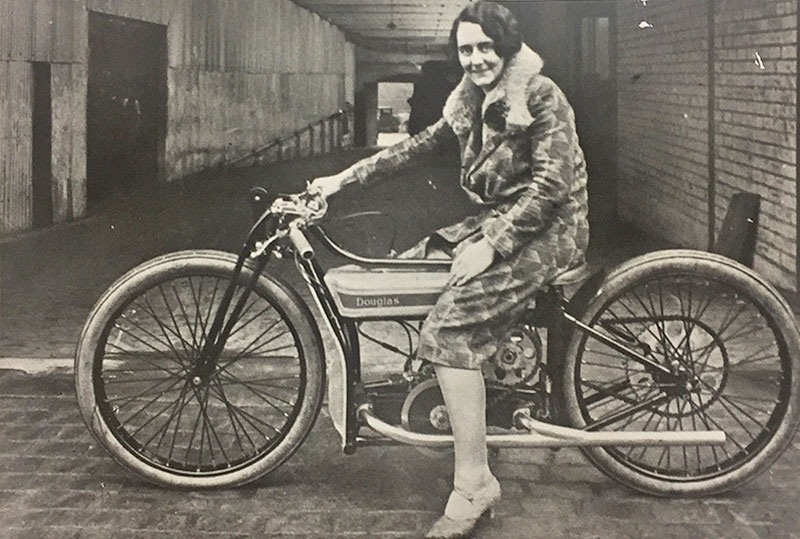
Fay Taylour at Douglas Motorcycles, Kingswood, 1929
Ben is looking for information about this photograph. Fay Taylour's politics were obnoxious, she was an ardent Nazi sympathiser, but at one time she was one of the greatest speedway riders in the world, male or female. Ben wants to know when this photgraph was taken, who took it, and at agency or collection the original is now in.
Thrissell Street Chapel (Easton)
Original query from Helen, Australia
I am trying to find a little more information about my mother's days growing up in Bristol. I can find no reference to the "Thrissel Street Chapel" (I have her hymn book from 1929) and is it possible to access records from the Hannah More Girls School that I believe she attended, possibly around the same time.
My Reply
Although Helen used Thrissel I think the correct spelling is Thrissell, which is in Easton. According to Pigot's Directory for 1830 there was a Thrissel Street, a couple of maltsters named Richard Hooper and Richard Norris lived there in that year. The Living Easton site (Internet Archive) says that Thrissell Street was named after Edward Thrissell a 19th century rope-maker and that between 1826 and 1846, 70 houses built were built there. Dr. W. G. Grace, M.R.C.S., L.R.C., the famous cricketer had his surgery in Thrissell Lodge. Later he and his wife, Agnes (Internet Archive), moved next door to Thrissell House, where they remained until around 1896. These were demolished sometime after 1972 and Easton Leisure Centre built there around 1990. Paul Taylor's site (Internet Archive) say's that the Creese family also lived in Thrissell Street in the 1890's. Bristol's Lost Pubs says that the Neptune there was in 1847, run by W. Baker and in 1848/49 by William Pearce. Some of the inhabitants of Thrissell Street in 1851 are given in the Rootsreb Wessex L Archives (Internet Archive).
The ChurchCrawler site (Internet Archive) says that the Baptist church was designed by Henry Crisp in 1854. It has long since been demolished, and now even the exact site is uncertain, but is again thought to be where the Leisure Centre is now. According to John Silas Merritt's "A Complete History of Old King Street Baptist Church, Bristol" (Internet Archive) the Baptist Itinerant Society was formed in 1824 under Mr. Thomas Robert's immediate auspices, along with "the assistance of the energy and zeal of the churches at Broadmead, Counterslip, and Thrissell Street."
There are many sites that mention Hannah More and her school. The first was opened in 1758 at 6 Trinity Street, College Green but many others followed.
Troopers Hill
Original query from Susan
Susan is a member of the Friends of Troopers Hill and is looking for more information on the area. You really should look at their website, it's a marvellous piece of work.
My Reply
Given the importance the area played in Bristol's industrial history I'm surprised that I can find so little about the area. What little I did manage to find I've put on my Troopers Hill page. One site I did find in my searches was entitled "A History of Tar Distillation at Crews Hole, Bristol" (Internet Archive)
Mary Sophia Twitcher
Original query from Sue
Sue is looking for information on a Bristol teacher, Miss Mary Sophia Twitcher. She was the Head Assistant at Fairfield School, Montpelier, Bristol from 1901-1909 and Headmistress at Whitehall School from 1910 until her death in 1926.
Vine House, Bedminster
Original query from B Tadghighi
Does anyone know the history of Vine House, Clifton Street, Bedminster?
Wards of Bristol
Original query from Valerie
Valerie is researching her family tree and emailed me that "My great great grand father was Arthur Hawkins Ward who was Warden of St Raphael's College from 1889 and Vicar from 1893-97. The Library at Clifton had a fair bit of information on him. He founded The Sisters of Charity and died at The Warden's Lodge, Knowle on the 23rd of October 1908. He was buried at the Arno's Vale Cemetery and I have a photograph of his grave.
However, I believe he was buried along with his mother Maria Gertrude Ward who died around 1881 (she appears in the 1881 census - aged 85) but no mention is made on the photograph of the gravestone I have. Neither am I able to trace the date of her death and wondered if there would be any mention in the cemetery records and how I go about obtaining this."
Valerie would also be very interested in contacting any DEVIS or MARTIN from Bristol. Agnes Margaret Ward married Harry Francois Devis in Bristol in 1892 and had several children. One daughter Margaret Mary Devis married Owen Sidney Martin in 1919 and had a son Arthur. The other Arthur Devis married Hilda Victoria Larking in Fulham in 1922 and two of their children were Anthony F Devis (1924) and Geoffrey N Devis (1925)
Reply from Barb :-
Barb writes that Maria Gertrude Ward's tombstone is beside that of her son in Arno's Vale Cemetery. She was born 7th December 1795, and died 8th September 1886. There is also a Mary Emily Irene Ward born 28th November 1864, died 2nd February 1938.
Barb Drummond is the author of "The New Eden" - the first book about Arno's Vale Cemetery.
Barb has informed me that the cemetery records are in various places. Books of remembrance are at the Evening Post offices. The records of burials are still thought to be at the cemetery and some other records are at the Record Office which is still in dispute with the owner of Arno's Vale.
"Wassfink of ee den, wass fink of ee"
Original query from Eric
Eric remembers a song from the 1950's called "Wassfink of ee den, wass fink of ee". The nearest I can think of is "Don't Tell I, Tell 'e" by Adge Cutler and the Wurzels, but this wasn't released until 1968.
Reply from Zider Ed :-
Zider Ed writes the website Scrumpy and Western, everything you needed to know about West Country musicians. He writes, "I've also been trying to find out about this song. I heard Adge Cutler mention it and I've been trying to find out more info ever since, without success. Adge mentioned 3 songs "Wassfink Of 'Ee, Den", "Thee Bissn't Gonna Get'n Out Of I" and "Thee's Better Keep Thee Eye On 'Ee". As you can tell from the titles, they be all in Bristle. I believe they were written and sung by a bloke called Len "Uke" Thomas - I assume from his nickname that he used to play the ukulele, but I haven't been able to find out anything about him. I guess he would have been around in the 50s or 60s but no idea when exactly. I asked Fred Wedlock and he knew the name but wasn't able to throw any light on it. It'd be good to find out if anyone has the words and/or music for the songs, or if Len ever recorded any of 'em. Another possible clue (but it could be a red herring) is that Adge wrote the song "Ferry To Glastonbury" with a bloke called Colin Thomas. Could he be connected with Len "Uke" Thomas."
I've added a short piece about Len "Uke" Thomas on the Virtute et Industrial page.
Water Street, St. Paul's
Original query from Terry
My grandmother, Lilian Sandle, was born at No 3 Water Street, St. Paul's, Bristol, in 1892. Her parents were Joseph Sandle, a 'sewn boot maker', and Priscilla Sandle, formerly Malpas. (details are from Lilian's birth certificate) The 1901 census returns a list of addresses for Water Street, but no No 3! Numbers run from 8c to 40 with a few numbers missing. I assume the street must have been gradually redeveloped over a few years. Can you shed any light on what happened to Water Street, where it was located and what is there now?
Reply from Carole
Carole writes, "There are two Lily/ Lilly Sandle's in the 1901 census. Lilly is 9 and parents were Joseph and Elizabeth. Lily is 12 and her parents were Charles and Clara."
If anyone has any information on the Sandle's or Water Street we'd be grateful if you could contact me at or you can contact Terry directly at terry4911@tiscali.co.uk
Weare Street, Bedminster
Original query from Liz
Liz emailed saying that her great grandfather, James Williams lived in Bristol at 35 Weare Street, Bath Bridge, Bristol, in 1912. She cannot find the street on any map. His cousin was married to a John Edward Whittington Jones who lived at St. George’s House, 101 St. George’s Road, St. Augustine’s Bristol in 1903.
Reply from Ray
Weare Street ran between York Road and Mead Street from Bath Bridge to what is now St. Lukes's Road.
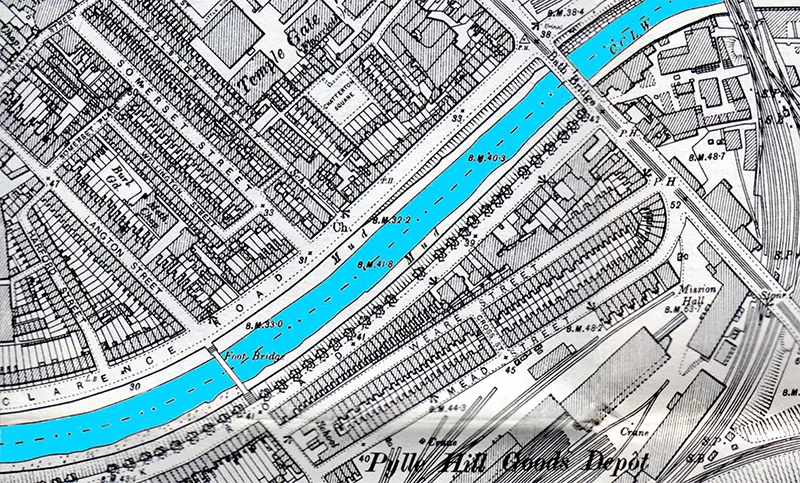
Image from 1902/3 Ordnance Survey map
I created a new page with everything I could find about Weare Street, if you know more, then please let me know.
James Wheeler
Original query from Glenys
Glenys is looking for information about her grandfather, James Wheeler, born around 1844. He was a glassblower and is said to have worked in a glass bottle factory. As his wife was an Irish lady, Glenys wonders if he was also Irish and brought over to work in Bristol. He and 5 others were later sent up North to help set up another factory. By 1868 he was back in Bristol, in Brickyard, where his family were born. His son also a glassblower moved approx. 1895 to Newport, South Wales he worked in the bottle factory.
Does any one know about the factory in Bristol? A list of the workers ? Addresses etc..?
Whitehall, Vine Cottage and the Old Georgians
Original query from Nikki
My father is looking for old photographs, documents or maps relating to the area of Whitehall. (A small area among Easton, Redfield and St. George.) Any information regarding a 'Vine Cottage' and possible other buildings in the area (like the history of the Old Georgians) would also be appreciated. If anyone can help, it would be of great interest to my father.
Additional query from Becky
My husband and I own the Kings Head public house on Whitehall Road and we have been trying to find out the history of the pub and the surrounding area. We have been told that the pub was once three cottages but can find no record of this. We have spent weeks on the internet and looking through records but can't seem to find anything at all. Apparently there were coal mines just up the road and The Old Georgians and the Packers field at the side of us are really well known. It would be wonderful to hear from someone who can throw some light on this and if anyone has any old photographs we would love to see them.
Reply from Ray
These queries were received several years ago, June 2003 and June 2004, resepctively. I had tried to find at least something about these subjects but it wasn't until the last day of 2012 that I received an email from a lady named Caroline who rekindled my interest in these subjects, especially the Old Georgians. Caroline's email was what prompted me to write about the Old Georgians on the St. George pages. Caroline is especially interested in the history of the building, the construction company that built it and so on.
Bert Williams and the Norman Family
Original query from Carol, Hamilton, Ontario, Canada
I'm hoping that someone may have some information on the photography studio, Bert Williams in Old Market. I have a photo from WW1 of my great and great grandfather, both William Norman and from Bristol. I think Bert Williams was related to my Norman family. Any information would be greatly appreciated.
Reply from Ray
It seems that Bert opened his photographic studio in 1916 at 7 Old Market Street. The last entry in the directories was in 1921.
If anyone has any information on Bert Williams or the Norman family we'd be grateful if you could contact me at or you can contact Carol directly at carol.a@quickclic.net
Edwin James Wiltshire
Original query from Geoff
Geoff is looking for information about his Great Great Grandfather. Edwin James Wiltshire was born in Fishponds in 1864, and became a mason and Master builder. He worked on various building projects around Bristol including the Kingswood Clock Tower and Two Mile Hill school.
He owned his own haulage company later in life and did very well out of this. It had some connection to Stevens coaches on Soundwell Road. Wiltshire Place, a small street in Soundwell was named after him, there has also been talk that he owned the lot!
He died on 8th February 1929 but there is no record of his burial place but he may have been buried at Two Mile Hill church (St Michaels).
As a side note Geoff mentions that his Great Grandfather, when he was young, used to play cricket with W.G. Grace in Downend.
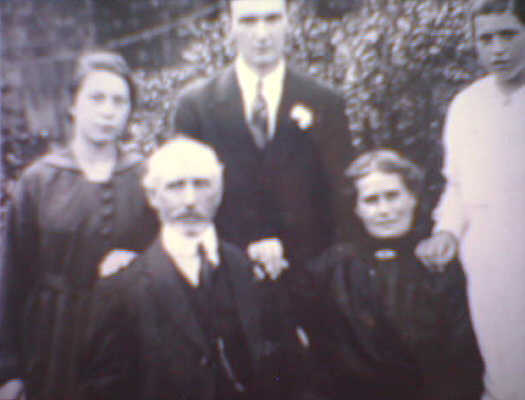
Edwin James Wiltshire is the older man in front of this group
If anyone has any information on Edwin James Wiltshire we'd be grateful if you could contact me at . If you prefer to email Geoff directly, his email address is geoffwiltshire@hotmail.com
Wine Street
Original query from Heather
Heather writes, "I am undertaking some research about Poets from Bristol. I wonder if anyone can point me in the direction of maybe maps or photos that show the exact spot at which 9 Wine Street was situated, and in the same street, the pub called "The Plume of Feathers".
Reply from Ray
9 Wine Street was the birthplace of Robert Southey. The building no longer exists as it was either bombed during WWII or demolished shortly after during the rebuilding of the area. The site is now marked by a plaque on the building that stands on the spot. There is an image of it on the About Bristol site.
As for the Plume of Feathers, I've no idea where this was. There is some information about the place on the Bristol's Lost Pubs site (Internet Archive).
Withywood
Original query from Amanda
Amanda would like to know some of the history of Withywood, especially in the monastery that used to be in the Withywood school area. Amanda would also like to know about any WWI bombing attacks on Bristol.
Yeamans or Yeomans
Original query from Arch
Arch is doing some family history research and is looking for information on Robert Yeamans, John Yeamans and also that of Edmund Yeamans or Yeomans.
Reply from Ray
Everything I know about the Yeamans now appears on the page I wrote because of Arch's query.